



INNOVATIVE LOW CARBON SURFACE PAVES THE WAY ON M5 MOTORWAY
LOCATION
M5 Motorway,
Junctions 28-30 Cullompton-Exeter
SECTOR
Infrastructure; Highways
CLIENT
National Highways
PRODUCTS USED
Prolay Ultra
THE BRIEF
A full scale demonstration site was set up between junction 28 and 30 of the M5 motorway to showcase a new standard adopted by National Highways.
The new E/21 Stone Mastic Asphalt (SMA) specification is a next generation, low carbon road surfacing standard which aims to tackle premature surface deterioration, inconsistent ride quality and the elevated carbon impact associated with frequent resurfacing cycles.
The project, part of the Low Carbon Innovation Fund, sought to validate the real-world performance of next-generation materials and to produce robust technical and performance data that will help inform the wider rollout of E/21 SMA across the Strategic Road Network.
Holcim UK was commissioned to provide the solution working closely with National Highways and Shell Bitumen.

Photo credit: Ant Clausen Photography/Peel Ports
What we achieved in numbers
From 10 to 20 years
Number of years surface lifespan increased by
3.3KM
Length of road resurfaced
20,000
Total volme of Prolay Ultra laid in tonnes
challenges
The project’s main aim was to overcome key performance challenges experienced on major roads, namely durability, consistent smoothness of ride and whole life carbon emissions.
Within the scheme itself the trial was commissioned under live traffic and operational conditions so traffic management and managed closures were a factor.
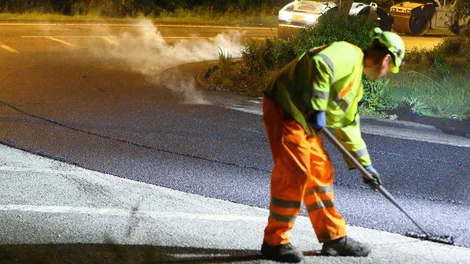
Project delivery began with the installation of temporary traffic management across a 3.3km section of the M5, undertaken under the supervision of Holcim UK and a Traffic Safety Officer.
Chevron deployed its EMCC Traffic Management (TM) system to provide a safe and efficient method for establishing the working area. EMCC allows TM installation to be undertaken ahead of the closure point using a controlled rolling block, where TM safety vehicles with flashing arrows create a protective buffer zone for operatives.
As with projects of this nature time constraints present an ongoing key challenge particularly with managed closures and the need to release parts of the carriageway back to traffic at key times.
Solution
Holcim UK provided its Prolay Ultra system for use in the project.
Designed with a carefully balanced aggregate matrix, increased bitumen content, and Polymer Modified Bitumen (PMB), ProLay Ultra achieves a low in-situ void content for enhanced resilience and long-term performance.
Due to Holcim’s forward-thinking approach to product development, ProLay Ultra already meets National Highways E21 SMA specification which is another reason it was commissioned.
The project delivery was supported by Smoothride digital paving control technology, integrating LiDAR scanning, 3D modelling undertaken by Driven International and MK Surveys and precision milling using Topcon and Wirtgen systems operated by Tripod Crest. Topcon’s SmoothRide technology delivers a fully digital and highly accurate approach to road resurfacing, utilising race track technology into the design of the road.
Using vehicle-mounted 3D scanners, the system captures precise surface data without the need for manual surveying. This information is converted into a detailed digital design, which guides milling machines and pavers to automatically adjust depth and alignment in real time.
By optimising every stage of the process, SmoothRide produces exceptionally smooth and consistent pavement surfaces, reduces material waste, increases efficiency and significantly shortens programme durations. The result is a faster, more accurate and sustainable method of delivering high-quality resurfacing across complex highway environments.
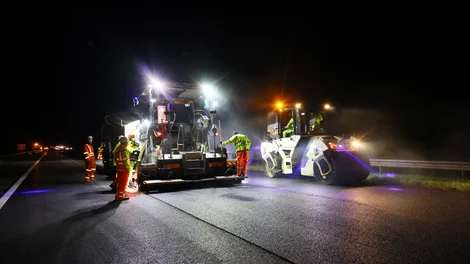
This meticulous process, coupled with echelon paving, eliminates weak joints and ensures a consistently smooth and durable surface.
All surfacing operations, including full pavement construction, were delivered by Holcim crews with 20,000 tonnes of materials being supplied directly from Holcim’s plants at Westleigh in Somerset and Moorcroft in Plymouth.
Throughout the scheme, Holcim’s Quantity Surveying team maintained clear and consistent communication with all stakeholders. Daily diary and resource sheets provided transparency on labour, plant and material usage, while weekly progress meetings with the broader value chain ensured alignment on programme performance, risks, weather impacts and commercial controls. This structured approach ensured the project remained on schedule and within budget.
The new E/21 specification is designed to extend pavement life from 15 to 20 years through the use of high-grade Polymer Modified Bitumen (PMB) and a low-void structure, enabling improved durability, fewer maintenance interventions and reduced whole-life carbon.
Holcim’s AIT system was employed across the scheme, which delivers the latest digital quality control processes throughout the project. This included material mapping from plant to site, temperature monitoring across all stages of manufacture and installation, digital footprint of each load laid on site, and compaction mapping of rollers. The latest laser scanning was employed by TRL, which showed full compliance with the new CC202 standards.
Early monitoring of the scheme has shown strong and consistent performance, with results meeting and exceeding the expectations set by the E/21 specification. Laboratory testing has confirmed that ProLay Ultra satisfies all durability, rutting and ageing requirements, validating its suitability as a long-life, high-performance surface course. Ongoing assessment will continue to track long-term behaviour and whole-life carbon benefits.


Neil Leake, National Technical Manager for Contracting at Holcim UK, said: "This project represents a benchmark for showcasing genuine industry innovation. By installing ProLay Ultra, we have successfully demonstrated compliance with the rigorous new CC202 E/21 SMA Surface Course specification, proving the viability of our next-generation, long-life asphalt.
“The integration of motorsport-level precision and high-definition LiDAR scanning allowed us to accurately model the existing pavement topography, delivering an exceptional final ride profile. Executed via seamless echelon paving, this collaborative initiative sets a new standard for infrastructure resilience and demonstrates exactly how the highways of the future should be constructed."
“Completed in January 2026, the resurfacing of the M5 southbound between Junctions 28 and 30 shows how National Highways is making it easier to use proven, lower‑carbon approaches in everyday road maintenance.
“As part of this scheme, our surfacing contractor Holcim supplied and laid a long‑life asphalt surface that meets the CC202 E/21 standard. The material is already proven in use and is designed to last longer, reducing the need for future maintenance and cutting carbon over the life of the road.
“Smoother paving techniques, supported by digital scanning, were used to achieve a more even road surface. This has delivered a noticeably smoother and quieter journey for road users and has the potential to reduce vehicle fuel use. This project supports the aims of the Low Carbon Demonstrator Fund by helping remove barriers to the wider adoption of proven low‑carbon materials and methods, while continuing to maintain a safe and reliable road network.”
Steve Aldridge, Project Manager
Relevant Products

Related Case Studies and News























Contact us and get a quote
For more information on about the project or products used in the case study
or to find out how we can help with your next project, please get in touch.
