



LOW-CARBON CONCRETE INNOVATION THE RIGHT FIT FOR WESTMINSTER OFFICE RETROFIT
LOCATION
17-19 Rochester Row,
Westminster, London
SECTOR
Commercial
CLIENT
V7, Meadow Partners, WFG
PRODUCTS USED
ECOPact
THE BRIEF
Designed by BGY, the redevelopment of 17–19 Rochester Row by V7 and Meadow Partners aimed to transform an existing 1980s office building into a highly sustainable, future-ready workplace through a retrofit-led approach.
Rather than demolishing and rebuilding, the project sought to prioritise structural reuse, material innovation and collaborative delivery to significantly reduce embodied carbon while creating best-in-class office accommodation.
The scheme is introducing flexible, high-quality workspaces alongside improved public engagement, enhanced occupier wellbeing and ambitious environmental performance targets aligned with net-zero carbon objectives.
The refurbishment will unlock the full potential of the existing structure through a redesigned street frontage, extension of bay windows to ground level, and a rooftop pavilion connected via a new stair and lift core.

What we achieved in numbers
79 cubic metres
Total volume of ECOPact low carbon concrete supplied
70 tonnes
Voluime of clean concrete waste recovered and recycled
35 %
Percentage of embodied carbon saved as a result of low-carbon concrete in piling
challenges
From the outset the project set out to deliver a retrofit-first policy with 90 per cent of the structure of the original 1980s office block to be preserved.
Parts of the existing concrete structure, which were identified as not being part of the new design, were earmarked for removal for recycling purposes.
Bespoke low carbon concrete mixes were required to meet the ambitions of the scheme to be net zero in construction and operation and to achieve the desired sustainability targets including BREEAM Outstanding, WELL Platinum and Nabers 5 star.
Solution
Recognising in-situ concrete as a key contributor to embodied carbon, Workplace Futures Group (WFG) collaborated with Holcim UK to explore the available low-carbon concrete solutions.
Drawing on knowledge gained from the Holcim Innovation Center in Lyon and visits to Holcim UK’s recycling operations at Morden Wharf in Greenwich, the team investigated mixes aligned with British Standard BS 8500:2023 low-carbon concrete standards.
The adopted approach introduced ground calcium carbonate (GCC)/limestone fines as a cement replacement, resulting in a reduction in embodied carbon.
Locally sourced GCC was used which reduced reliance on GGBS, maintained comparable embodied carbon reductions, supported local material sourcing and achieved sustainability gains with no cost impact.
Two mixes were developed by Holcim UK and approved by the structural engineers Whitby Wood. These were:
- LC30/33 CIIB-S lightweight concrete, achieving a more than seven percent embodied carbon reduction compared to a traditional CEM I concrete baseline.
- C32/40 CV-SL structural piling mix, achieving a more than 35 percent carbon reduction.
All embodied carbon savings were verified through third-party calculations by Circular Ecology.
Circular economy principles were also embedded within the construction delivery.
A total of 70 tonnes of clean concrete construction demolition material (CDM) was collected from the site and transported to Holcim UK’s London recycling facility at Morden Wharf.
The waste concrete was processed into recycled concrete aggregate (RCA) and redistributed for use in new concrete mixes across other London projects.
Although reuse within the same project was not feasible due to the specific lightweight concrete requirements, the recycling strategy supported BREEAM waste performance objectives.
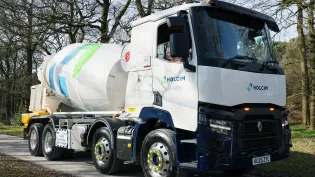
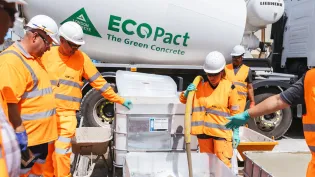
To ensure transparency and measurable outcomes Holcim’s ECOPact low-carbon concrete was specified for the project, supplied locally from its Battersea Readymix plant, which helped minimise transport emissions.
ECOPact* achieves at least a 30 percent lower GWP (kg CO2e/m3, A1-A3 scope) compared with the applicable Ordinary Portland Cement.
Project-Specific Environmental Product Declarations (EPDs) were produced — representing a UK-first level of lifecycle carbon reporting accuracy for concrete. These EPDs provided a verified and standardised assessment of carbon impact across the material lifecycle.
*ECOPact achieves at least 30% lower GWP (kg CO2e/m3, A1-A3 scope) compared with the applicable Ordinary Portland Cement (CEM I/Type I) concrete reference.


Anh Nguyen of Specification Manager for Holcim UK said: “17–19 Rochester Row demonstrates how refurbishment, material reuse and low-carbon innovation can collectively reshape existing office assets into high-performance workplaces.
“Through structural retention, advanced concrete solutions and circular economy practices, the project provides a replicable model for reducing embodied carbon across the commercial real estate sector.
“The scheme stands as an exemplar of how collaboration across design, engineering and supply chains can accelerate the industry’s transition toward concrete decarbonisation and net-zero construction.”
“Our first engagement with Holcim and the team was a visit to the circular hub in Greenwich where we saw firsthand their CDM material processing capabilities. Following this visit, the Ambit team, our subcontractor Northvale, and Holcim worked together to find sustainable solutions for our project at 17-19 Rochester Row.
“The results of this early engagement from the team were brilliant, sending back 60t of CDM to be recycled back into mixes, and specifying much less carbon intensive solutions that worked for all parties. Holcim provided bespoke EPD’s for all mixes supplied to site, really helping to validate our carbon emissions for the project and support our carbon reduction journey. I could not recommend them enough and we really value the support they can provide at all stages of our projects.”
Matt Robinson
Head of Sustainability,
Workplace Futures Group
Relevant Products
Related Case Studies and News











Contact us and get a quote
For more information on about the project or products used in the case study
or to find out how we can help with your next project, please get in touch.
